This article was originally written and published by idziemy, a Polish magazine. Google Gemini was used to translate this article from its original Polish writing to English. Gemini's accuracy cannot be guaranteed, nor do the views expressed in this article necessarily represent those of the Business Ethics and Society Program. Please find the original article here.
They are delighted by our hospitality, history, and… food. Students from the Business School at the University of Notre Dame in Indiana, USA, are visiting Poland once again. What brings them here?
The journey of these young people is part of the "Business, Ethics and Society" program conducted at the aforementioned prestigious Catholic university. For them, Poland represents an interesting example of a young free market. The fact that it is the country of origin of St. John Paul II is also significant. During their stay in Poland, they meet with business executives who prioritize ethics in business. They visit Warsaw, Kraków, Wieliczka, and Wadowice. They also visited the Sejm and were received by the US Ambassador, Mark Brzezinski.
Theology and Entrepreneurship
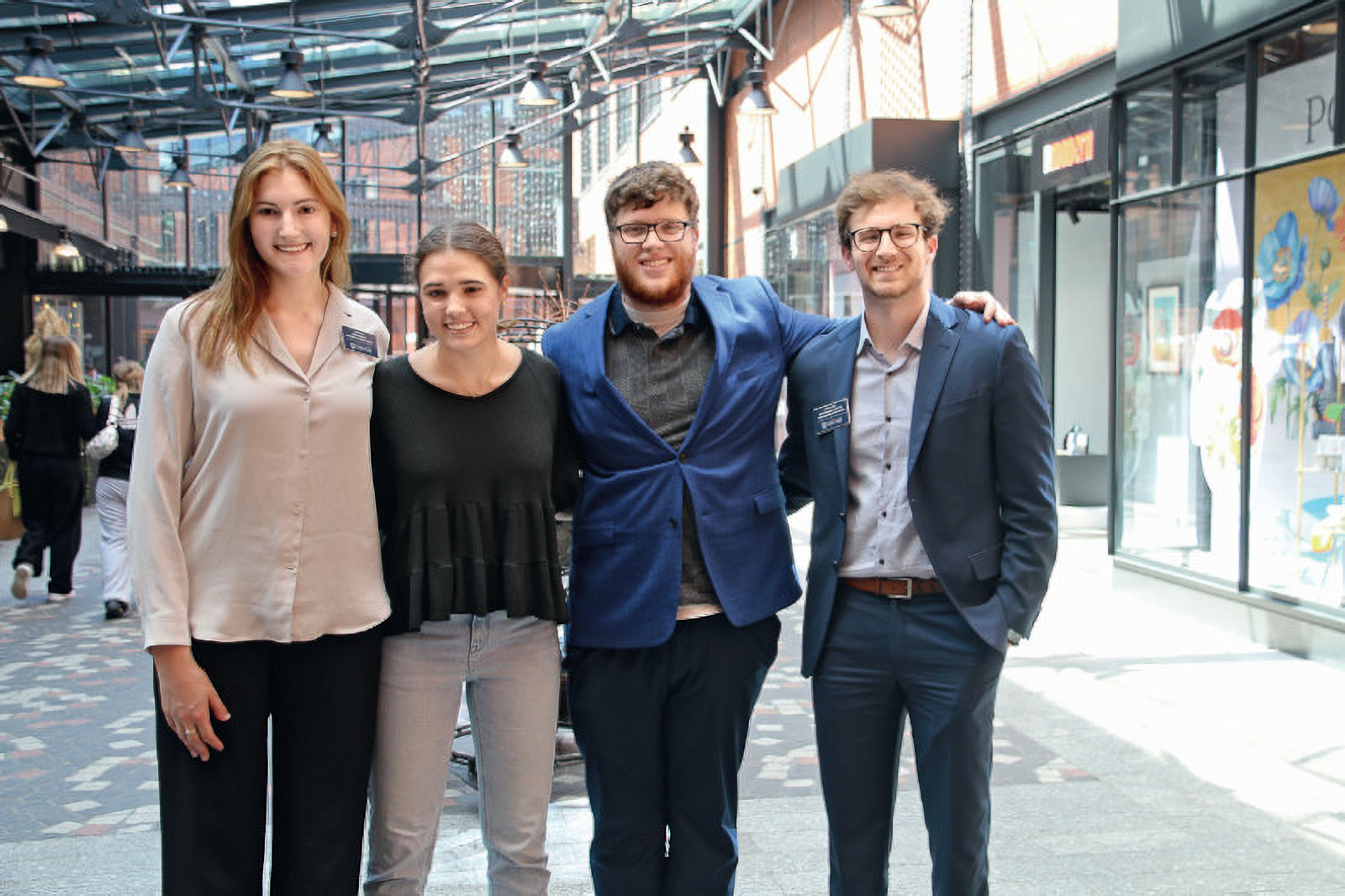
I meet with the initiator of these trips, John Sikorski, and a group of students in Warsaw’s Powiśle district. The business ethics lecturer from the University of Notre Dame came here not only with the youth but also with his wife, Monica, and their seventh child – a daughter just a few months old. He speaks Polish fluently; both of his parents come from Poland. His father, as a doctoral student at the University of Warsaw, left for the USA and was supposed to return to the country on December 13, 1981. He stayed in the United States, and after a few years, his wife managed to join him. John was born in New York. As a high school student during World Youth Day in Toronto in 2002, he experienced an inner transformation. "I started taking faith seriously; I became fascinated by Christ through His action in John Paul II," he says. It was during this WYD that he met his future wife. After completing studies in philosophy and theology and obtaining a doctorate in moral theology, he worked in a diocese as a layman responsible for adult catechesis. However, he lost his job during the pandemic, and his large family found themselves in a difficult situation. Then, employment opportunities opened up at the Catholic university, where the dean was launching a program aimed at introducing a humanistic approach, the perspective of virtues, and Catholic social teaching into business. The trip to Poland takes place as part of the university's international programs and serves as the culmination of a colloquium on ethical business in a global context.
American students first visited Poland last year. The goal is experiential learning – learning through experience. Last year's group met, among others, with the president of the SuperDrob company, which has been cooperating with the "Idziemy" weekly for years through the "Uskrzydlamy" Foundation. It was also a kind of pilgrimage, e.g., visiting places associated with St. John Paul II. The positive feedback from the students led another group of Business School students to travel to Poland this year.
A Hospitable Reception
"This is one of my students' observations," John replies to the remark that Polish residents do not evaluate the situation on the Vistula so positively. "Poles often speak very poorly of their country, while our students are delighted," he adds. They liked, for instance, how entrepreneurs combine professional work with family life. They also notice that it is a Catholic country with many churches, and the people they meet speak openly about their faith.
John is aware that they were dealing with a selected group of businessmen. However, since he began visiting our country in the early 90s, he has noticed positive transformations. "I have been to Poland twelve times. I had a longer break between 2014 and 2023. Over those nine years, a huge change has occurred. The standard of living has risen, although unevenly," he notes. In his opinion, despite the complaining, we are proud of our country.
Lucca Kessler Linnéz, a student from Brazil, is positively surprised that their interlocutors so highly value Poland’s history, drawing lessons from the past. American Allison Willner emphasizes the perseverance of Poles shaped by historical turmoil (the students visited, among others, the Warsaw Uprising Museum). Julia Warden, of Croatian origin, notes that the visit allows her to understand the effects of communism, but also the country's potential for the future. Everyone emphasizes the hospitable reception. "People are very empathetic," says Anto Arano, a student of Peruvian origin. American Clay Chauncey adds that some people traveled for several hours to meet them. "There is a culture of openness to people from another country here," adds John Sikorski. "Poles like to argue among themselves, but they have open arms for others."
Lucca emphasizes that they met with business leaders who do not just seek "profit for profit's sake," but pay attention to the well-being of employees and customers, as well as the broader impact of the activities they conduct. Anto notices a lot of determination to strive for more.
The Pope's Country
The magnet attracting people to Poland is undoubtedly the figure of St. John Paul II. While still a student, John came to Kraków to study for half a year. He visited places associated with Karol Wojtyła. He sets himself the goal of spreading the legacy of the Polish Pope. "There is a reason why God places us in a given place and time and gives us specific gifts," he reflects. His knowledge of the Polish language, combined with his theological education and upbringing in the USA, gives him the opportunity to spread knowledge about the life and teaching of the saintly pope.
John recalls the words of St. John Paul II, that freedom is not only given but also assigned as a task. "I am curious which way your country will go. Will Poland try to build its own vision of the future based on its heritage, Catholicism, the role of faith, and national history? The Pope, especially in the 90s, reminded his compatriots that now is the moment to use freedom in a responsible way. In Poland right now, there are many options – will this freedom be used to serve society, or will there be further secularization and demographic decline? Will Poland build its own vision of the future as part of Europe, but as a sovereign nation?" John wonders.